|
Getting your Trinity Audio player ready...
|
Written by: Davina Kaur
Britain is an increasingly wealthy country with growth consistently on the agenda. Yet for many people, economic security feels dauntingly out of reach. Food bank use remains at an all time high, housing costs place growing pressure on household incomes, and owning a home is feeling impossible for younger generations. All while the UK’s wealthiest 1% hold the total wealth proportionate to the combined wealth of the least wealthy 50% of households. (In the April 2020 to March 2022 period)
So, if the economy is growing, why is there less to go around?
This question is becoming increasingly difficult for policymakers to avoid especially with the popular debate in most headlines circling taxing billionaires to redistribute wealth. Economists Gabriel Zucman and Ben Tippet (who proposed this policy) estimate a 2% minimum tax on UK households with more than £100 million in wealth, could raise around £10 billion a year.
However, the significance of this debate goes beyond taxation. It raises a more fundamental question about how Britain’s economy distributes wealth.
Income is what we earn. Wealth is what we own.
For most people, income comes primarily from work. We exchange our time and skills for wages, which are then used to pay for housing, food, transport and other necessities. But wealth is different. It is ownership, it can grow through possession of a home, land, a business, shares, pensions or other assets. It grows with the economy and not based on the hours you put in through labour.
Imagine two people earning the same salary. One is able to buy a home with help from their family and the other rents because they cannot afford a deposit. Both work. Both contribute to the same economy. But if property prices rise over the next decade, the first person may accumulate substantial wealth through the increasing value of their home, while the second continues to pay rent (likely with rent increases) without gaining an equivalent asset.
The difference is not necessarily how hard either person worked. It is what they were able to own and start with.
Ownership provides more than financial value. It provides security, resilience and control. For example, an asset can be passed between generations, used during financial difficulty or to generate further income. Therefore, owning a building gives an organisation more control over its future than renting it. And owning land gives its owner significant influence over what happens to it.
This is why inequality cannot be understood through income alone.
Who gets to own?
Britain’s starting point has never been equal.
The relationship between race, wealth and debt cannot be understood through individual financial choices alone. It is shaped by the conditions under which people enter the economy: the wages they can earn, the assets they can access, availability of social security, and whether affordable financial services are available when things go wrong.
These inequalities date back to colonialism, a history of wealth and resource extraction from across the Global South, creating patterns of economic power that did not disappear with decolonisation. The consequences of that history are not a simple line from colonialism to present-day poverty, but they form part of the unequal economic structures within which countries and communities continue to build wealth.
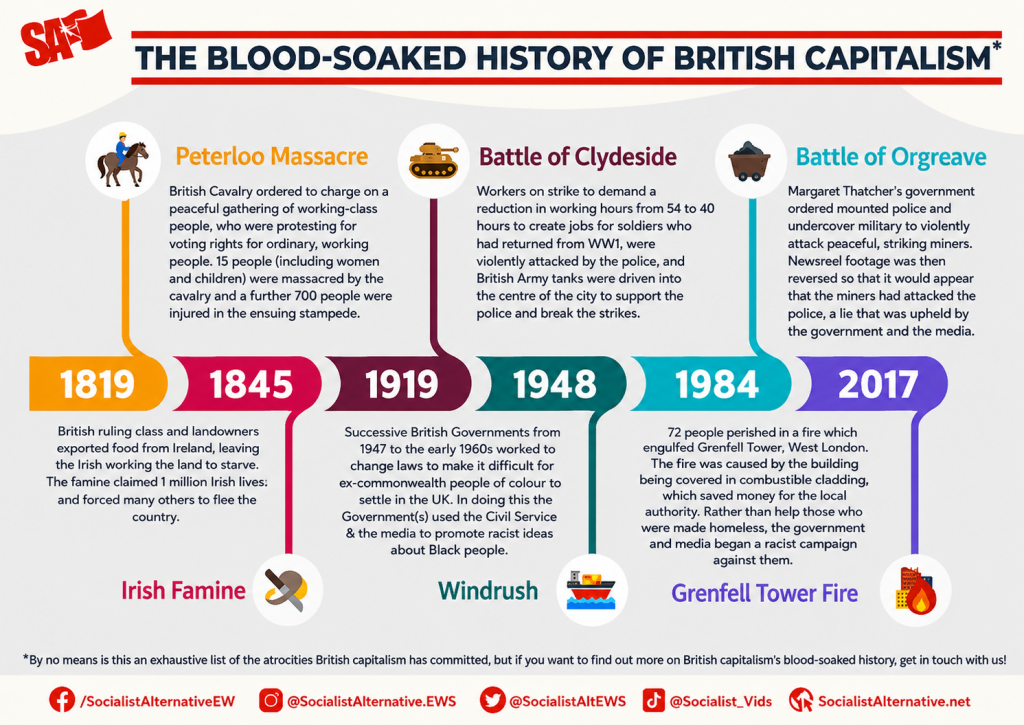
The Office for National Statistics data show substantial differences in household wealth between ethnic groups. In its analysis, White British households were around nine times as likely to be in the highest wealth quintile as Black African households and 18 times as likely as Bangladeshi households. The median total wealth of Black African households was estimated at £34,300, compared with £282,000 for White British households in the period analysed. ONS also found significant differences after accounting for characteristics including age, education, housing tenure and household composition.
These figures are not simply differences in income. They are differences in the assets available to provide security and to be passed to the next generation.
The same pattern can be seen in the labour market.
Racialised communities continue to experience significant pay gaps. In 2022, median hourly pay was £13.53 for Black employees compared with £14.35 for white employees, while Pakistani and Bangladeshi workers had median hourly pay of £10.00 and £9.60 respectively. These differences persist even when qualifications are taken into account e.g. among graduates, Black men earned 17 per cent less than white men.
The significance of these gaps extends beyond the monthly payslip. Lower income means less capacity to save, invest and acquire assets. When more of a household’s income is needed to meet basic costs, there is less available to build the financial foundations from which wealth can grow.
That has consequences at community level too.
A neighbourhood where residents have little property ownership is more exposed to decisions made by landlords, developers and external investors. A community organisation that rents its building can lose that space when a landlord decides to sell or when a local business can be priced out when commercial rents increase. When regeneration raises land values, the financial gains are felt by those who own the land rather than those who have lived, worked and built relationships there.
This creates a contradiction at the heart of Britain’s economy: communities can create enormous social and economic value without owning the assets through which that value is created.
For racialised and working-class communities, this is particularly important. Across Britain, community organisations provide food support, youth services, cultural activity, mutual aid and spaces for people to organise. Yet the organisations providing this infrastructure often operate from buildings they do not own and rely on short-term funding.
The issue is therefore not a lack of community capacity. It is a lack of economic power and control.
From taxing wealth to changing ownership
This is why the debate around wealth taxation matters, but also why it cannot be the end of the conversation. A wealth tax asks: how should wealth that has already been accumulated be redistributed?
Community Asset Ownership asks a different question: How can communities own more of the assets that shape their economic future?
These are not competing ideas. They address different parts of the same problem.
Taxing extreme wealth can redistribute resources towards public services and social investment. It can challenge a system in which those with the greatest accumulated wealth contribute proportionally less than they should. Thus, the emerging political debate around wealth taxation matters, particularly at a time when public services and local government face significant financial pressures. However, redistribution is not ownership and both mus exist to address wealth inequalities.
Community Asset Ownership can include community land trusts, cooperatives, development trusts and community-owned buildings and infrastructure. The common principle is that assets are owned or controlled collectively so that their value can remain available to the communities that depend on them.
This matters because ownership changes power.
- A community-owned building cannot simply be sold by an external landlord.
- A community land trust can protect land for local priorities rather than allowing its value to be determined solely by its highest commercial use.
- A community-owned asset can generate income that is reinvested locally rather than extracted from the neighbourhood.
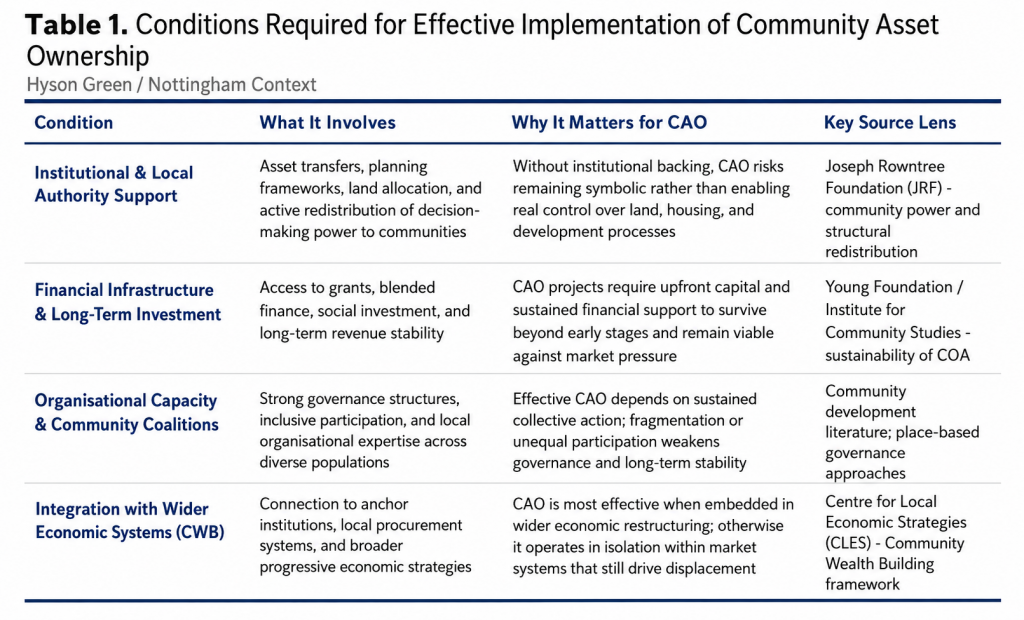
My research through the Power to Prosper programme in Hyson Green, Nottingham, highlighted why this matters.
Hyson Green is a diverse neighbourhood with a long history of migration, community organising and local enterprise. Yet our research identified pressures including increased private renting, studentification and changing retail patterns. Conversations with residents suggested that the concern was not simply whether investment should happen, but who would benefit from it and whether existing communities would remain able to shape the future of the neighbourhood.
Regeneration may often present as inherently positive because investment can improve buildings, infrastructure and services but when your community no longer feels catered to and represented by the retail it’s surrounded by, it begins to push out familiarity and convenience. If communities no longer feel locally appreciated, part of the investment debates and saving less from rising costs, people are forced to leave.
Community Asset Ownership offers one way of changing that relationship. It gives communities a stake in the assets around them and, with it, greater capacity to determine how those assets are used.
But goodwill and the chance to purchase does not address structural inequalities that make ownership so difficult in the first place. If the government is serious about addressing wealth inequality, it needs to look beyond taxation. National policy should support community ownership through long-term and affordable finance, stronger Community Right to Buy powers, greater support for Community Land Trusts and dedicated funding for communities seeking to acquire local assets. Community Wealth Building should also be embedded into regeneration policy so that public investment builds local economic power rather than simply increasing the value of assets that are subsequently captured by private owners.
For Andy Burnham, this means that a fairer tax agenda should not stop at asking how much more the wealthiest can contribute. It should also ask how wealth and ownership can become less concentrated in the first place. A wealth tax could help redistribute accumulated wealth and fund public investment; community ownership could help ensure that future economic value is retained within communities rather than continually flowing upwards and outwards.
This is particularly important for racial justice.
If racialised communities have historically been disadvantaged in wealth accumulation, then policies that simply assume everyone can participate equally in the existing ownership system will reproduce those inequalities. Economic justice requires confronting the unequal starting points created by history while changing the institutions that continue to reproduce them.
Power to Prosper challenges a powerful assumption that communities should primarily participate in the economy as workers, consumers and tenants, while ownership remains concentrated elsewhere.
If Britain is serious about tackling inequality, the question should therefore be bigger than who earns what.
We should also ask:
Who owns the land? Who owns the buildings? Who benefits when their value rises? And who gets to decide what happens next?
That is not simply a question of economics and better financial management . It is a question of power and, ultimately, of racial and economic justice.
Footnote
Rather than viewing land and buildings solely as financial assets, Community Asset Ownership treats them as long-term social infrastructure. A community centre is not simply a building to generate rental income; it is a place where relationships are formed, services are delivered and local identity is sustained. When these assets are owned collectively, communities gain greater certainty over their future. They are less vulnerable to changing landlords, speculative redevelopment or the sale of land to external investors.
Appendix
- https://powertoprosperuk.org/power-to-prosper-a-recap-on-how-communities-are-building-wealth-through-ownership/
- https://www.lse.ac.uk/research/research-for-the-world/society/inequality-feeling-poor
- https://cep.lse.ac.uk/_NEW/PUBLICATIONS/abstract.asp?index=10074
- https://www.lse.ac.uk/research/research-for-the-world/economics/financial-feminism-hidden-costs
- https://patrioticmillionaires.uk/who-we-are