
Drivers of Debt explores how racialised debt and poverty in Britain are not the result of individual failures, but the predictable outcomes of historic and ongoing systems that are built on and that promote social and economic inequalities.
Power to Prosper’s community-led approach ensures that research is done both by and for real people living with poverty and debt and that it is used to practically improve their lives. Drawing on community-led research in Lambeth, Newham, Nottingham and Manchester, Drivers of Debt connects the dots between Britain’s colonial past, continuing structures of exclusion, and racialised poverty and debt today. The message is clear: tackling racialised debt requires confronting the systems that create it and building an economy rooted in justice, security, and shared prosperity.
The Structures that Bind Us
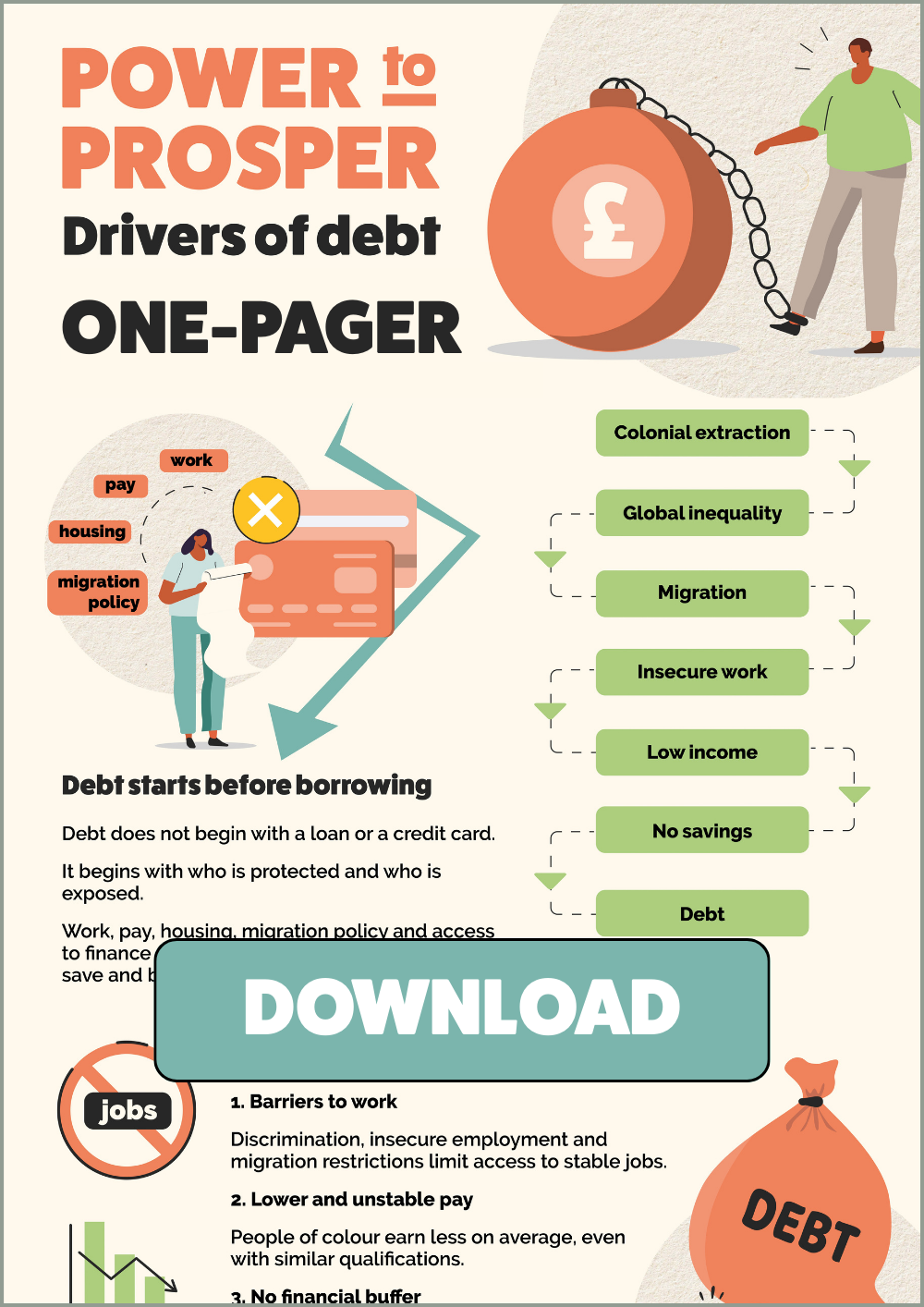
Debt doesn’t start with a loan or credit card. The same structures that extracted wealth from the Global South continue to shape who gets to build wealth in Britain. Many countries once colonised by Europe remain trapped in debt to their former colonisers. For example, countries in the Global South paid $2.5 trillion in interest payments between 1970 and 2022 [1]. Migrants, including refugees in the UK face restrictions such as No Recourse to Public Funds (NRPF), visa limits, and low-paid insecure work, making them twice as likely to rely on high-cost credit compared to other low-income families [2].
The Income we’re Denied
Workers of colour consistently earn less than their white British peers. In 2022, the median hourly pay for Black employees (£13.53) lagged behind white employees (£14.35) [3]. Pakistani (£10.00) and Bangladeshi (£9.60) workers remain the lowest paid [3]. Even with similar qualifications (for example, among graduates), Black men earn 17 per cent less than white men [4].
These gaps are structural, not personal, and push many households of colour into debt.
The Wealth we Can’t Build
Even when incomes are similar, households of colour have far less wealth than white households [5]. Homeownership – the main route to wealth in the UK– remains far less accessible for Black and Pakistani households, making it harder to pass wealth from generation to generation. [5]. Without savings or assets, unexpected events like illness, job loss, or the rising cost of living can quickly push families into high-interest borrowing.
The Exclusion We Face
Racism impacts every step of life for people of colour: from school, to work, and accessing financial services. Many people of colour face barriers to accessing affordable credit due to discrimination in lending, digital and ID exclusion, and biased algorithms[6]. Left with few options, many are forced to rely on payday loans and other high-cost borrowing, creating what participants called a ‘cycle of survival’.
References
[1] Debt Justice. Colonialism and Debt, 2022. Available at: https://debtjustice.org.uk/wp-content/uploads/2022/08/Colonialism-and-Debt-briefing.pdf
[2] Joseph Rowntree Foundation. Families with No Recourse to Public Funds Are Trapped in Hardship, 2025. Available at: https://www.jrf.org.uk/deep-poverty-and-destitution/families-with-no-recourse-to-public-funds-are-trapped-in-hardship
[3] Office for National Statistics. Ethnicity Pay Gaps, UK: 2012 to 2022, 2023. Available at: https://www.ons.gov.uk/employmentandlabourmarket/peopleinwork/earningsandworkinghours/articles/ethnicitypaygapsingreatbritain/2012to2022
[4] Institute for Fiscal Studies. Britton, J., Dearden, L., van der Erve, L., and Waltmann, B. The Returns to Undergraduate Degrees by Socio-Economic Group and Ethnicity, 2021. Available at: https://ifs.org.uk/sites/default/files/output_url_files/R186-The-returns-to-undergraduate-degrees.pdf
[5] Office for National Statistics. Household Total Wealth in Great Britain, April 2020 to March 2022, 2025. Available at: https://www.ons.gov.uk/peoplepopulationandcommunity/personalandhouseholdfinances/incomeandwealth/bulletins/totalwealthingreatbritain/april2020tomarch2022
[6] Adami, R. (2024). Financial Exclusion in the UK: Evidence on Ethnicity. Glasgow Caledonian University. Based on analysis of the UK Family Resources Survey 2018–19. Available at: researchonline.gcu.ac.uk/files/97812027/97695133.pdf